Showing posts with label Audi. Show all posts

Thursday, May 6, 2010

2011 Audi Sports Car RS5

The 2011 Audi RS5 made its world debut last month at the 2010 Geneva Motor Show and come complete with an uprated version of the 4.2-liter FSI V-8 from the RS4. The latest iteration of the sweet engine delivers 450 horsepower at 8,250 rpm and, between 4,000 and 6,000 rpm, transmits a maximum of 317.15 pound-feet of torque.
2011 Audi RS5
The mighty engine is matched to a seven-speed S tronic dual clutch gearbox and a new center differential in the standard quattro all-wheel drive system. Together, the powertrain propels the coupe’s 3,803 pound kerb weight from 0-62 mph in 4.6 seconds and sees it reach a top speed of 174 mph.
Despite the performance, the new RS5 has relatively good--for a performance car--fuel economy of 21.8 mpg for the European combined cycle.
Developed by quattro GmbH, the RS models comprise the dynamic spearhead of Audi's model range. The Audi RS5 is the latest torchbearer in a tradition dating back over 15 years to the RS2 Avant: superior handling in the mid-size class. A close relative of the V10 which powers the high-performance Audi R8 sports car, the high-revving V8 engine delivers its output from a displacement of 4,163 cm3. Like nearly every Audi gasoline engine, this one also operates via direct fuel injection known by the abbreviation FSI. This same technology has propelled the Audi R8 racing car to four triumphs at the classic endurance race in Le Mans. The common-rail system generates up to 120 bars of pressure.
Intensive fine-tuning of the dual-branch intake and exhaust system allows the undersquare engine to breathe freely; four adjustable camshafts and tumble flaps in the intake manifold facilitate mixture formation. The 4.2 FSI provides imposing torque and is right at home even at high revs - almost like a race engine. The engine delivers 331 kW (450 hp) at 8,250 rpm and - between 4,000 and 6,000 rpm - transmits a maximum of 430 Nm (317.15 lb-ft) of torque.
The vigorous strength, the spontaneous responsiveness, the joyful high-revving, and the throaty, sonorous music: this V8 produced by hand at Audi stunningly combines the essence of power and emotion. The 4.2 FSI propels the coupé's 1,725 kilograms (3,802.97 pounds) in 4.6 seconds from 0 to 100 km/h (0 to 62.14 mph) to an electronically governed top speed of 250 km/h (155.34 mph). Audi can increase that to 280 km/h (173.98 mph) upon request.
The RS 5 will ride on a lowered and stiffened suspension, and it most certainly will have a torque-vectoring rear differential similar to that which we recently sampled in the 2010 S5 cabriolet. Also look for an RS-specific calibration of the Audi Drive Select system that allows the driver to tailor steering effect, damping qualities, and transmission/throttle response to his or her tastes. We expect the RS 5 to make abundant use of lightweight materials such as aluminum, magnesium, and probably a conspicuous sprinkling of carbon fiber, á la BMW M3 coupe, as part of its ambitious plan to begin reducing vehicle mass across its model lineup and particularly among its performance cars.
A carbon design package is available for the engine compartment and, for the vehicle body, there are styling packages in black or matt aluminum look, including for the exhaust system, which can be fitted with black tailpipes. The new RS5 is scheduled to go on sale in Europe this July and previous spy shots of prototypes testing in the U.S. suggest the car will also be in local showrooms.
Sales of the Audi RS5 will begin in the spring of 2010. Its basic price will be approximately 77,700 euros.

Tuesday, May 4, 2010

2011 Audi Sports Car TT Coupe Roadster

Dynamic design, enthralling performance and exemplary efficiency - the Audi TT Coupe and the TT Roadster are now more attractive than ever. The design of the lightweight bodies made primarily of aluminum and the interior have been revised with great attention to detail, while new technologies lower the fuel consumption of the compact sports car. New to the lineup is a powerful and highly efficient four cylinder: The 2.0 TFSI develops 155 kW (211 hp), but is content with an average fuel consumption of just 6.6 liters per 100 kilometers (35.64 US mpg).
2011 Audi TT Coupe and Roadster
The Audi TT Coupe and Roadster models enter the 2011 model year with some modest exterior styling changes, a revised interior and the introduction of the firm's new 2.0-liter TFSI gasoline engine with 211 ponies on the entry-level versions. The new 2.0 TFSI delivers 211HP and 258 lb-ft, or 11-horsepower and 51 lb-ft of torque more than its 2.0-liter predecessor. With the six-speed manual, the two-liter engine accelerates the Coupe from zero to 100 km/h (62mph) in 6.1 seconds on its way to a top speed of 245 km/h or 152mph.
The upgrades to the Audi TT Coupe and the TT Roadster have added two centimeters (0.79 in) to both cars, which now measure 4,187 millimeters (13.74 ft) in length. The width of 1,842 millimeters (6.04 ft) and the height of 1,352 millimeters (4.44 ft) and 1,357 millimeters (4.45 ft) for the Coupe and Roadster, respectively, remain unchanged. The wheelbase measures 2,468 millimeters (8.10 ft). Four new metallic colors have been added to the TT color range: Scuba Blue, Oolong Gray, Volcano Red and Dakota Gray. Daytona Gray, pearl effect is also available with the S line package.
The Audi TT 1.8 TFSI weighs a mere 1,240 kg (2,733.73 lb), a good 100 kilograms (220.46 lbs) less than its closest competitor. The body of the Coupés weighs only 206 kilograms (454.15 lb), which breaks down to 140 kilograms (308.65 lb) of aluminum (68 percent) and 66 kilograms (145.51 lb) of steel (32 percent). The specific reinforcements in the TT Roadster - steel bulkhead, strongly ribbed sills, A-pillar and windshield frame - result in a 58 to 42 percent split of the two materials.
The designers have added additional gloss to the fine interior. New aluminum-look applications shine on the steering wheel, the center console and in the door liner. Elegant accents are provided by rings, frames and strips in high-gloss black. The aluminum strip above the glove box door is now brushed gray. There are three new interior colors from which to choose - nougat brown, titanium gray and garnet red. The leather seat covers are specially treated to reduce thermal heating by as much as 20 degrees Celsius (68° F) when the Audi TT is parked in the sun.
The Audi TT Coupe and the TT Roadster are sports cars with a high degree of everyday utility. The backs of both rear seats fold down in the 2+2-seater Coupé, expanding the trunk space beneath the long lid from 292 to 700 liters (10.31 - 24.72 cubic ft). The Roadster, which offers 250 liters (8.83 cubic ft) of storage space whether the top is up or down, can also be supplied with the option of a load-through facility.
The S line sport package features a black interior with many fine details in such places as the steering wheel, the seat covers and the applications. 18-inch wheels and body lowered by 10 millimeters (0.39 in) make the handling even more dynamic.
The updated Audi TT Coupe and the TT Roadster will debut on the German market in the summer of 2010 with only minimal changes in price. The 1.8 TFSI will be available from €30,200.

Monday, April 26, 2010

2009 Audi Sports Car roadster/coupe TT-RS

Although the 2009 Audi TT has improved greatly on previous models in terms of general fun-factory and handling, enthusiasts still don't place it in the same league as the M Coupes, Boxter/Caymans and S2000s of the world. The S line model, which debuted in 2008, served up a big helping of improvements, but Audi fans still wanted more.
2009 Audi TT-RS
Audi is once again producing a five-cylinder engine – and a very special one at that. Arriving at dealerships this summer, the TT RS has a turbocharged 2.5-liter engine with direct gasoline injection; it produces 250 kW (340 bhp) and 450 Nm (331.90 lb.-ft.) of torque. The blazing five-cylinder engine enables the TT RS to perform extraordinary feats. In conjunction with quattro permanent all-wheel drive and a high-performance chassis, the engine makes the compact Audi TT RS a top-notch sports car – available as a coupé or roadster.
Sporty five-cylinder gasoline engines have a long legacy at Audi. The most famous is arguably the turbocharged 2.1-liter engine in the Audi quattro. The first version, which was launched in 1980, offered an impressive 147 kW (200 bhp). And the Sport quattro from 1984, directly inspired by motorsport, delivered a whopping 225 kW (306 bhp). For 25 years, turbochargers and quattro have been a dynamic formula for success.
Audi has resumed using this recipe. Designed from scratch, the five-cylinder engine combines a turbocharger with FSI direct gasoline injection to elevate the TT RS to a high-performance sports car. The TFSI delivers 250 kW (340 bhp) from a displacement of 2,480 cc (151.34 cu in): a specific output of 100.8 kW (137.1 bhp) per liter.
The power-to-weight ratio is also outstanding. In the case of the Coupé, which weighs in at a mere 1,450 kilograms (3,196.70 pounds), the power-to-weight ratio is just 4.3 kilograms per bhp.
The TT RS Coupé rockets from 0 to 100 km/h (0 to 62.14 mph) in 4.6 seconds; the Roadster needs just a tenth of a second longer. The limited top speed of 250 km/h (155.34 mph) is merely the official figure for both versions; as an option, Audi can increase it to 280 km/h (173.98 mph).
Almost even more impressive is the aggressive pulling power. The maximum torque of 450 Nm (331.90 lb.-ft.) is always available between 1,600 and 5,300 rpm. In addition, the TT RS overtakes without the slightest effort. Last but not least, its engine makes passengers’ skin tingle time and again thanks to its speedy and powerful response, its inspiring free-revving character, and its unmistakably guttural tailpipes: five-cylinder classical music by Audi!
As an uncompromising sports-car engine, the 2.5-liter TFSI is ultra-compact. Just 49 centimeters (19.29 inches) in length, it is ideally suited for transverse installation in the TT RS. And its weight of just 183 kilograms (403.45 pounds) also sets a record. The crankcase is made of vermicular-graphite cast iron. This high-tech material unites the utmost in strength with low weight; it has otherwise only been used for the large TDI engines from Audi. Perfectly placed reinforcements enhance the block’s loadability. The lightweight cylinder head, the pistons, and the connecting rod are lightweight as well as high-strength.
The ultra-powerful five-cylinder engine is extremely fuel-efficient, requiring an average of just 9.2 liters/100 km [25.57 mpg] as regards the Coupé (Roadster: 9.5 l/100 km [24.76 mpg]). Switchable flaps in the intake manifold mix the incoming air in a calculated configuration. Injected at a pressure as high as 120 bar by the common-rail system, the gasoline swirls intensely in the combustion chamber – which in turn cools the walls. This subsequently facilitates a compression ratio of 10.0:1, which is very high for a turbocharged engine. Both of the adjustable camshafts, controlled via chains, also enhance charging efficiency with respect to the air-fuel mixture.

Tuesday, April 6, 2010

Audi A0 QS Sports Car Concept

This small and dynamic sports car is created by Russian designer Alexander Tiganova, the Audi A0 QS concept is an eco-friendly sports car, equipped with a hybrid drivetrain, consisting of an electric motor and a hydrogen engine.
Audi A0 QS Concept
The Audi A0 QS is a stylish and innovative automobile concept with stunning aesthetics and great performance. Q stands for four-wheel drive, while S stands for sports. This small and dynamic sports car has been specially designed for athletes and rich people to enhance their active lifestyles.
Audi A0 QS Concept
The concept vehicle comes with electric motor and a hydrogen engine, due to which the car is entirely hybrid. Some of the most significant features of the car include a special rotation system of the wheels with an analogy of the three-wheeled trike, making the wheels able to bend without rotation along the vertical axis.
Audi A0 QS Concept
The “Q” in the concept car’s name stands for four-wheel drive and the “S” for support, according to the designer. This Audi concept car’s doors are made from a rubber fabric, that can turn transparent, depending on the driver’s needs. With a length of just 3.4 meters, this futuristic vehicle would have a great advantage when driving on busy urban roads, or when parking.
 Audi A0 QS Concept

Tuesday, March 23, 2010

2010 Audi A8 Hybrid Concept Car at The Geneva

At the Swiss international auto show Audi has introduced its new A8 Hybrid. According to the producers, though the vehicle is designed as a concept of the gasoline-electric hybrid version, it is scheduled to enter the mass production next year. Audi revealed today the details of the upcoming A8 Hybrid Concept, set to make its official debut at the Geneva Motor Show.
2010 Audi A8 Hybrid Concept Car
Audi fits its largest sedan with a familiar 2.0-liter, turbocharged 4-cylinder engine and then mates it to a 45-horsepower electric motor for a combined 245 system horsepower. A lithium-ion battery pack is stored in the rear. According to Audi, this efficient flagship will accelerate to 60 mph in about 7.5 seconds and reach a top speed of 146 mph. Best of all, the 5-passenger full-size luxury sedan earns the equivalent of nearly 38 mpg on the EPA cycle.
2010 Audi A8 Hybrid Concept Car
Power like a big V6, fuel economy like a modest four-cylinder unit - Audi presents the Audi A8 Hybrid Concept as a technology concept at the 2010 Geneva Motor Show. Its two propulsion units - a 2.0 TFSI and an electric motor - develop a total output of 180 kW (245 hp) of system power and 480 Nm (354.03 lb-ft) of torque. This enables the Audi A8 Hybrid to accelerate in 7.6 seconds from zero to 100 km/h (62.14 mph) and to achieve a top speed of 235 km/h (146.02 mph). Yet its average fuel consumption amounts to only 6.2 liters (37.94 US mpg) per 100 km - the CO2 equivalent is 144 grams per km (231.75 g/mile).
2010 Audi A8 Hybrid Concept Car
The combustion engine of the Audi A8 Hybrid Concept is the 2.0 TFSI - a high-tech powerplant. This four-cylinder unit, which has been named "Engine of the Year" five times in a row since 2005, is an example of Audi's downsizing philosophy. It combines direct fuel injection with turbocharging and the AVS Audi valvelift system, which regulates the valve lift in two stages. In combination with the adjustable intake camshaft, the Audi valvelift system improves cylinder charging and ensures spontaneous and powerful torque build-up. The 2.0 TFSI delivers 155 kW (211 hp) and 350 Nm (258.15 lb-ft); the torque value remains constant from 1,500 to 4,200 rpm.
2010 Audi A8 Hybrid Concept Car
A hydraulically operated wet clutch links the 2.0 TFSI with the electric motor. Its control requires the utmost precision, and a great deal of know-how has been expended to achieve its smooth, precise and swift operation. The synchronous motor, which is continually excited, also serves as a generator that develops 33 kW (45 hp) of power and 211 Nm (155.63 lb-ft) of torque.
2010 Audi A8 Hybrid Concept Car
The energy storage system of the Audi A8 Hybrid Concept is mounted in the rear section. This state-of-the-art lithium-ion battery is more compact and weighs less than other types but is substantially more powerful. It is protected by a high-strength housing, and a ventilation module ensures that it always operated within the ideal temperature range. Yet the Audi A8 hybrid Concept also provides ample luggage space of 400 liters (14.13 cubic feet). Several subsystems that operate on engine power in a conventional car have been modified right from the start for use in the Audi A8 Hybrid Concept. The compressor in the climate control system runs entirely on electric power.
2010 Audi A8 Hybrid Concept Car
The power electronics unit manages the interaction of the systems. Its pulse control inverter regulates the interplay of the battery and the electric motor. The DC-DC converter supplies power to users on the onboard network. The power electronics unit, which is connected to the battery and the electric motor by high-voltage cables, is located in the engine compartment. The smooth interaction of these components and their high level of integration attest to the specialized know-how Audi has accumulated. The technology architecture already provides a glimpse of a future production model - the Audi Q5 hybrid, which will be introduced later this year.
2010 Audi A8 Hybrid Concept Car
The engine compartment cover with its high-gloss finish and the glass cover of the battery in the trunk also provide visual links to hybrid technology. And the illuminated doorsteps bear the "hybrid" insignia as an elegant touch to underscore the electric aspect whenever the doors are opened - using LED technology to minimize energy consumption.
2010 Audi A8 Hybrid Concept Car
The passengers also see the prominent hybrid logo displayed on the dashboard. Some of the most significant features of the hybrid vehicle include 21-inch, two-color alloy wheels, a special paint job and the so-called “Powermeter”.
2010 Audi A8 Hybrid Concept Car

Saturday, February 6, 2010

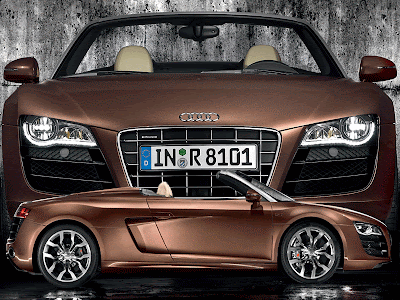
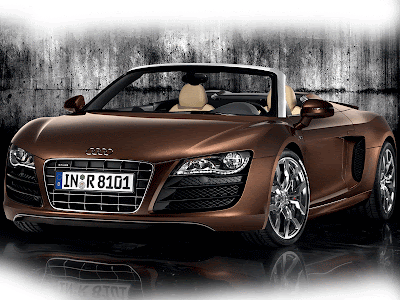
2010 Audi R8 Spyder 5.2 FSI quattro V10 engine

2010 Audi R8 Spyder 5.2 FSI quattro V10 engine

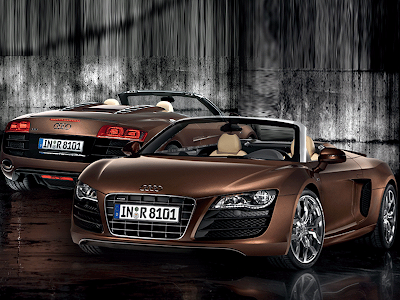
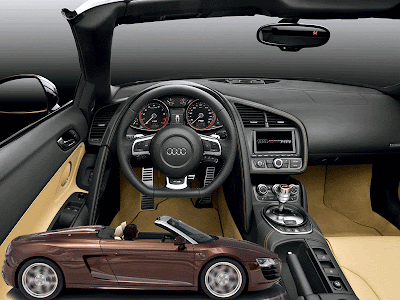
While everybody and their brother likes the R8, there is a small, but vocal minority that's always thought coupe looked a little funny. Well, that group of naysayers can now put a sock in it, as the R8 Spyder is simply gorgeous. Gone are the carbon fiber side blades, in are sensible but somehow better looking slab sides. Regardless, it's simply hot. Exceptional performance and breathtaking dynamism coupled with the intense sensations of open-top driving: Audi presents the R8 Spyder 5.2 FSI quattro. Its lightweight cloth top opens and closes fully automatically; several body parts are made of a carbon fiber composite material.
2010 Audi R8 Spyder 5.2 FSI quattro V10 engine

The V10 engine produces 386 kW (525 hp) and launches the open-top two-seater to 100 km/h (62.14 mph) in 4.1 seconds; 0 – 200 km/h (124.27 mph) in 12.7 seconds; on its way to a top speed of 313 km/h (194.49 mph) with the six-speed manual transmission. The 5.2-liter engine features FSI direct fuel injection. Equipped with a manual transmission, the R8 Spyder 5.2 FSI quattro consumes an average of 14.9 liters of fuel per 100 km (15.79 US mpg) – a good figure given its power. With R tronic, this figure improves to 13.9 liters (16.92 US mpg). Featuring technologies such as the Audi Space Frame (ASF), quattro permanent all-wheel drive, full-LED headlights and with an innovative seatbelt microphone available as an option, the R8 Spyder 5.2 FSI quattro is the new top-of-the-range Audi.
2010 Audi R8 Spyder 5.2 FSI quattro V10 engine

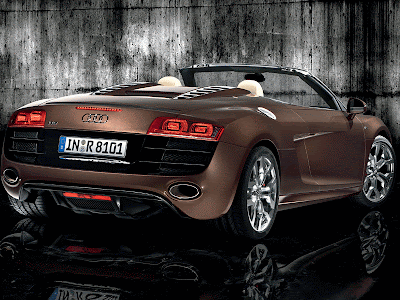
Unlike the Coupé, the Spyder does not have sideblades behind the doors. The side panels and the large cover over the storage compartment for the cloth top are made of a carbon fiber composite. Two arched cowls, which extend to the spoiler lip and include large, integrated air vents, give the rear of the open-top two-seater a powerful profile.
2010 Audi R8 Spyder 5.2 FSI quattro V10 engine

The electrohydraulic soft top opens and closes in 19 seconds, even while driving at speeds up to 50 km/h (31.07 mph). When opened, it folds like a Z into its storage compartment over the V10 engine. The compartment cover opens and closes automatically. The heated glass window, which is separate from the cloth top, is lowered into the bulkhead. It can be independently raised and lowered at the press of a switch, with the top up or down. Audi offers the R8 Spyder 5.2 FSI quattro with a choice of three colors for the top. The body is available in eleven paint finishes, with metallic and pearl effect finishes standard. The windshield frame is coated with anodized aluminum. The leather for the seats are colored with pigments that reflect the infrared component of sunlight, which keeps the seats up to 20 degrees Celsius (68 degrees Fahrenheit) cooler.
2010 Audi R8 Spyder 5.2 FSI quattro V10 engine

A worldwide first is the optional seatbelt microphone for the hands-free unit, which makes it possible to talk on the phone even with the top down on the highway. Three small, flat microphones are integrated into both seatbelts. At least one of them is ideally positioned relative to the speaker when the belt is on. There is a fourth microphone in the windshield frame. 
2010 Audi R8 Spyder 5.2 FSI quattro V10 engine

The quattro permanent all-wheel drive features a central viscous coupling and distributes power to all four wheels with a heavy rear bias. It works together with the locking differential on the rear axle to provide significantly greater traction, stability, cornering speed and precision. It is the superior technology – in particular for a high-performance sports car.
Related Posts with Thumbnails