Showing posts with label 2011. Show all posts

Tuesday, June 15, 2010

2011 Ford Saleen Cars S302 Debuts at Carlisle Ford Nationals

Saleen Performance Vehicles is unveiling the latest product in its premiere line of high-performance cars, the 2011 Saleen S302 Ford Mustang. The debut will take place this weekend at the Carlisle Ford Nationals in Carlisle, PA. This is the first Saleen vehicle launched this year, following the successful launches of the 435S and S281 in 2009.
2011 Ford Saleen Cars S302
The Saleen S302 is based on the 2011 Ford Mustang 5.0-litre, thrust is provided by the same V8 engine and it pushes out 317 kW (425 bhp / 431 PS) while torque is 536 Nm (395 lb-ft). Drive is through the rear wheels via a 6-speed manual transmission and a limited slip differential.
The Saleen S302 is builds on the Saleen tradition of offering limited-edition, high-performance vehicles for enthusiasts who are looking for an exhilarating driving experience, with refined drivability for real-world road conditions. Available in both coupe and convertible body styles, the S302 boasts a premium level of design consideration, both exterior and interior, with performance to match.
“We’ve taken high performance vehicles to the next level with this S302 Saleen,” said Michael Timarac, Brand Manager, Saleen Performance Vehicles. “The S302 is being built now and will be in dealerships in the coming weeks. I’m proud of this product and those who value performance vehicles will agree that the S302 is one of the best American exotic vehicles available on the market.”
The S302's exterior design features carefully crafted sculptural detailing, with lines and forms that flow naturally and suggest suppleness, power and agility. Exterior features include 20-inch, 7-spoke alloy wheels with Pirelli P-Zero high-performance tyres, a strong but elegant front grille and a simple integrated rear wing. The S302's 5.0-liter V8 engine produces 425 hp and 395 lb.-ft. of torque, sent to the rear wheels through a six-speed manual transmission and a limited-slip differential with 3.73:1 final drive ratio.
Inside an atmosphere of style-meets-sport exists, encouraged by such items as leather sports seats, chevron-like Ultrasuede red tabs in the seatback bolsters, Saleen logos on door panels, as well as unique gauges, steering wheel and gear shifter. The interior features new, leather sport seats with Ultrasuede inserts, highlighted by chevron-like Ultrasuede red tabs in the seatback bolsters, and unique treatments of the gauges, steering wheel, center console and shifter. There also are contrasting Saleen logos in the door panels, and Saleen logos in the door sill plates that illuminate when the door is opened.

Thursday, June 10, 2010

2011 New Opel Astra GSI Concept Cars Third Millennium

The new Opel Astra GSi will be unveiled in October at the Paris Auto Show and will go on sale later this year or early in 2011. The 2011 Opel Astra GSi will feature various new design elements, including a re-styled front bumper, new wheel arches, a small rear diffuser and double exhaust pipes.
2011 New Opel Astra GSI Concept Cars Third Millennium
Opel fans al already asking when will the new Astra GSI will make its debut. Today we have the answer for them: the new 2011 Opel Astra GSI will make its debut this autumn at the Paris Motor Show, according to the latest reports from Auto Motor und Sport.
The new Opel Astra GSi 5-door layout back to talk about himself, with eloquent spy photos. The famous symbol will return to sport compact Russelsheim later this year. In fact, the Astra GSi will officially introduce yourself to October at the Paris Motor Show and will be sharing the catwalk in Paris with the new Sports Cars Tourer estate.
The new vehicle will carry, as expected, a 2.0-liter Turbo engine which will deliver around 190 hp… we do hope that this will get at least 200 hp in order to take on the Vw Golf GTI. Regarding the OPC version this will carry over 240 hp. The new Astra GSI will also come with a new body kit which will include wider wheel arches, a new front and rear bumper, new side sills, dual exhaust pipes and a dual-tone interior with Recaro sport buckets. Most sources say the 2011 Opel Astra GSi will only be available in the 5 door body style. The 3 door will be sold only as a OPC / GTC.
The new Opel Astra GSi be the top version of the variant 5-door, while the symbol OPC will be given only to the three-door GTC. The 2011 New Opel Astra GSi third millennium will be equipped with the 2.0 Turbo petrol engine, whose maximum should be around 190-200 horses. The Astra OPC boasts a 2.0-litre turbocharged motor with 177kW. The GSI should feature about 140kW or so.
The sports chassis will be recognizable to the wider wheel arches and front bumper changed. At the rear, as well as the letters GSi, Opel Astra in this version will be distinguished for the double exhaust. Even in the cockpit there are specific characterizations, such as two-tone sport seats.
The Astra GSi price will be announced at a later date.

2011 New Chrysler Nassau Concept Cars will be launched later this year

According to U.S. sources the 2011 Chrysler Nassau will replace the Sebring as the next generation model (Chrysler Nassau concept cars pictured). The 2011 Chrysler Nassau will be the company's new mid-size sedan and will come on the market later this year. However, the 2011 Chrysler Nassau was not officially confirmed, nor denied for that matter. Although this name was used by the company for a 2007 concept cars , we should not expect the new 2011 Chrysler Nassau to look much like that concept.
2011 New Chrysler Nassau Concept Cars
The Chrysler designers have been working on completely new interior for the 2011 Chrysler Nassau and Dodge Avenger. The exterior will look substantially different. The 2011 Chrysler Nassau will offer the choice of two engines - 2.4-liter four-cylinder engine or a V6 Pentastar unit produced at Chrysler Trenton South engine plant.
Chrysler’s Sebring was never really anywhere near its competitors as far as its performance were concerned, which is why Chrysler has decided to make a fresh start with the car. And they have begun by giving the car a new name – Nassau – which is slated to hit the market in the last quarter of 2010 when it will replace the current Sebring.
The Nassau name plate was first seen on a concept car Chrysler had revealed in 2007. Chrysler also has a range of motorhomes available that are undergoing some modifications since earlier editions. Unlike the Sebring, motorhomes made by Chrysler are much larger and can accommodate more people in comfort. This type of vehicle is probably more suited to long distance travel and touring trips where motorhome hire is also an option for the vehicle.
The Chrysler’s Sebring is not being seen in good light of late, something that can be attributed to the sedan relying heavily on fleet and rental fleet sales with the majority of the grouse coming from the car’s interior quality which many claim is way behind what its competitors have on offer. Chrysler is of the opinion that the name ‘Sebring’ does not carry enough brand equity nor has any positive history associated with it that would make retaining the name for their all-new sedan really worthwhile.
“Chrysler bought the Nassau name when they came out with the concept, so it makes sense they would use it,” said Jim Hall, a consultant at a firm that is into advising automakers on future vehicles.
Another Chrysler Group model scheduled for replacement in the next 12 months is the Dodge Avenger. While little has been revealed on the new model (or whether it too will get a new name), previous reports suggested it would debut on a rear-wheel-drive platform as a sportier alternative to the Sebring.
That’s not all for there will also be an all-new Dodge Avenger to join the Nassau and is slated for a 2011 release with both the cars donning new interiors that Chrysler claims will match up to the best. The exteriors of the vehicles too will be a lot different so as to make them stand out as fresh new vehicles.
The 2011 Chrysler Nassau will be launched later this year. And The 2011 Chrysler Nassau price will be announced at a later date.

Monday, May 24, 2010

2011 Ford Start Concept Cars MEGA CITY

For parts of the world that are growing increasingly urban, the future of the automobile looks small, green, smart and fun in the eyes of Ford designers who created the Ford Start Concept. It's a design vision inspired for the transportation needs of the world's mega cities.
2011 Ford Start Concept
Making its global debut at the 2010 Beijing Auto Show, the Ford Start Concept is more than simply a design exploration into the feasibility of a small car. It also demonstrates how Ford will extend the promise of its EcoBoost engine technology story even further – previewing a fuel-efficient petrol Ford EcoBoost engine with just three cylinders and 1.0 litre of displacement, yet the power of a larger, 1.6-litre I4 engine.
Start Concept was inspired in part by a growing global trend toward mass urbanisation. The world's top 20 mega-cities are home to consumers whose needs, attitudes and expectations may have more in common with mega-city dwellers in other nations than with their own countrymen. While these consumers share the challenges of living in an urban society, they also increasingly seek out product solutions that bring the best the world has to offer.
When it comes to designing eco-friendly urban transportation, automakers have tried just about everything. They've drawn up bubble cars, autonomic pods, even semi-robotic unicycles. Ford however, has decided against cribbing from the pages of a sci-fi novel and opted for something far more conventional: a three-door hatchback. Specifically, the Start concept the automaker unveiled at the 2010 Beijing Auto Show.
“Our ambition was to design a car that transcends the practical realities of commuting in these mega cities, and goes beyond just dressing the technology,” said Freeman Thomas, design director. “We wanted to design a car you would also love.”
There’s little not to love about the Start, Ford’s first concept in three years, and the first developed under the global auspices of the “One Ford” mantra. Although the Start shows traces of Ford’s “kinetic” design language, its rounded form is much more elegant. Angular edges are limited to both the shoulder lines and the slender, LED-powered headlamp and taillights. Thomas says the Start features “refined surface language” usually found on premium vehicles, and we’d agree -- from some angles, the Start almost resembles Audi’s new A1.
Function doesn’t necessarily follow form, however, as stylists made an effort to improve the car’s aerodynamics. Many surfaces, including the windshield, side window glass, and center stop lamp, are flush with the body, while an underbody aero pan further reduces the Start’s drag. The interior is as equally stylish and functional -- the floating dual-cockpit dashboard lends a sporty look, but a conceptual infotainment system, billed as “MyFord Mobile,” incorporates a multi-function touch screen to simplify the center stack.
While the Start’s form allowed Thomas’ team to flex their creative muscle, the mechanicals beneath the car are firmly rooted in reality. Ford’s teased the idea of an EcoBoost three-cylinder, but this is our first look at such an engine. The turbocharged, 1.0-liter I-3 utilizes a cast-iron block, but a cylinder head and sump fabricated from cast aluminum. Ford won’t talk power figures, saying only that early tests suggest it can produce power on par with its 1.6-liter I-4, which is rated at 120 horsepower in North America. Power is routed to the front wheels via an ordinary five-speed manual transaxle.
Created by a global team of designers working at Ford's Irvine (Calif.) Strategic Concepts Group Studios, this sporty, futuristic concept combines near-production Ford EcoBoost engine technology and slick aerodynamics in an environmentally friendly package with reduced greenhouse emissions, all wrapped in an exciting design.
Ford says the EcoBoost three-cylinder would allow the Start to emit well under 100 grams of carbon dioxide per kilometer. That’s not a crucial figure here in North America, but it is in Europe, where Ford sells the similar-sized Ka. We doubt the Start is destined for production anytime soon, but look for the turbo-three to land in some small European Fords in the near future.
“The Ford Start Concept is the first pure concept we’ve developed under our ‘One Ford’ approach,” says Moray Callum, executive director, Americas Design. “J Mays, Martin Smith and I worked with Freeman and his team to deliver a concept that visually reinforces the fun to drive element that is at the core of the Ford brand DNA.”

Sunday, May 23, 2010

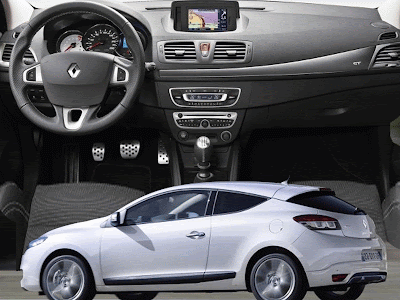
2011 New Renault Sports Cars Megane GT/GT Line


Renault Sports Cars Technologies has helped create two new sporting versions of Renault’s New Mégane – GT and GT Line. 2011 New Renault Mégane GT and GT Line, unveiled at the Geneva Motorshow in March, are available across of the body types that make up the Mégane family (Hatchback, Coupé, Estate, Coupé-Cabriolet) and go on sale in June.
2011 Renault Megane GT/GT Line
Meanwhile, the success enjoyed by New Mégane R.S. – which has already achieved number one status in France, and which holds third place in Germany and Spain – points to a healthy market for Mégane's sporting versions. Building on the reputation and success of its existing performance models, Renault now provides a sporting option for all the body types  that make up the Mégane family.
New Renault Mégane GT and GT Line demonstrate that motoring enjoyment can be affordable, and also serve as eloquent illustrations of Renault's new brand signature, 'Drive the Change' New Renault Mégane GT and GT Line are manufactured in the same factories as those that produce the core-range versions: Palencia (Mégane Hatchback, Coupé and Estate GT and GT Line), and Douai (Mégane Coupé-Cabriolet GT and GT Line).
These new versions bring distinctive styling and genuine driving emotions within reach of as many motorists as possible and also bridge the gap between mainstream Mégane and the allout performance credentials of Mégane R.S. GT Line is a Sport Pack which is available as an option on Mégane Dynamique equipment level versions. They feature a specific chassis and are powered by the Mégane’s core-range of economical and ecological engines. New Renault Mégane GT and GT Line stand out by their sporty styling cues both inside and out. Their sporty character is further accentuated by the Malta Blue body colour (which is exclusive to these versions) and by the Dark Metal (anthracite grey) or polished carbon finish of certain details.
New Renault Mégane Hatchback and Estate GT Line and GT inherit the same 'Sport' chassis as Mégane Coupé. As is the case with Mégane Coupé, the ride height has been lowered by 12mm. The GT Line and GT versions of new Renault Mégane Coupé-Cabriolet place the accent more on comfort and feature the same ride height as the standard model. Further exclusive touches include the polished carbon interior door pull handles, outer air-vents and dashboard trim.
Even more exclusive are the new Renault Mégane GT versions which come with 'GT' badging on the grille and 'GT Renault Sports Cars' badging on the tailgate. They sit on 18-inch Dark Metal-coloured Jetow aluminium wheels. Inside, 'GT' badging figures on the dashboard trim strip and front head rests, along with 'Renault Sport'2 branding on the door sills. Drivers will also appreciate the thick-rimmed leather-trimmed steering wheel incorporating thumb rests that was developed for Renault Mégane RS.
The engines available for new Renault Mégane GT and GT Line have been selected to meet customer demand and match the performance characteristics of each version. New Renault Mégane GT Line are available with the same engines as the mainstream Renault Mégane range and deliver a combination of driving comfort and impressive fuel consumption. GT versions are powered by the Renault Mégane range's more potent, more exclusive powerplants for even greater performance. The more exclusive Renault Mégane GT is available with either of the Mégane range's two most powerful turbocharged engines: the petrol TCe 180 or the diesel dCi 160.
The TCe 180 Euro5 (132kW) is a new evolution of the turbocharged 2.0-litre petrol engine and delivers outstanding driving enjoyment. With peak torque of 300Nm at 2,250rpm, it is extremely responsive and provides exceptional pick-up from low revs thanks to its twin-scroll turbo and continuously variable camshaft angle at the intake port which optimizes airflow into the combustion chambers and enables the turbine to spin up to speed more quickly. The turbo responds to the slightest touch of the accelerator from as low as 1,200rpm. This engine drives through a six-speed manual gearbox.
The dCi 160 Euro5 (118kW) is derived from the Alliance's 2.0-litre diesel turbo engine and is acclaimed as one of the most efficient of its class. With peak torque of 380Nm available from as low as 2,000rpm, this engine climbs smoothly and swiftly up the revs to 5,000rpm. Its 1,600-bar fuel injection rail, piezoelectric injectors, the advanced form of its pistons and its variable geometry turbo all contribute to making this four-cylinder diesel engine one of the most efficient in its class. The two balancer shafts efficiently filter out vibrations and contribute to an exceptionally quiet ride for even greater driving pleasure and comfort. The dCi 160 Euro5 engine is mated to a six-speed manual gearbox.

Saturday, May 22, 2010

2011 Saab 9-3 Convertible Luxury Sports Car

2010 Beijing Auto Show will be highlighted by the alternative-energy cars. Saab offers the 2010 model of diesel powered 9-3 Convertibles with 7% reduction in fuel consumption and CO2 emissions while keeping the performance as good as it was in older models. What the carmaker would like to emphasize is that there is no noticeable loss in performance.
2011 Saab 9-3 Convertible Sports Car
The 2011 Saab 9-3 Convertible handles as well as anything else out there. Steering and breaks on the Saab 9-3 Convertible's are masterfully engineered to be quick and sure. The standard engine pulls its weight with aplomb, and for those with a thirst for more power, the turbocharged 210-horsepower is deceptively quick.
Saab's new concert quality 300-watt sound system has no equal. Ventilation settings and seat positions can be saved in Saab'ss onboard computer. For those who seek even more performance, check our home page for links to retailers who offer 2011 Saab 9-3 convertible accessories you can order online. The BMW 3 Series interior space is not as large as the 2011 Saab 9-3 and neither is the trunk as cavernous. The new 9-3 is an above average entry-level luxury sports car that will give people cause to think twice about BMW.
There are two different versions of the 2011 Saab 9-3's new turbocharged 2.0-liter inline four-cylinder engine. 175 horsepower and 195 pound-feet of torque are produced by the low-pressure turbo base engine coupled with a five-speed manual standard or a five-speed automatic.
The change is due in part to Saab’s ongoing EcoPower Technology development strategy, which concentrates on optimizing efficiency and minimizing the environmental impact of its products. The low emission diesel variants with the 150 hp/110 kW, single turbo 1.9-liter engine can generate 145 g/km CO2and fuel consumption of only 5.5 l/100 km over the combined cycle. Cars that have the 180 hp/132 kW, two-stage turbo power results to 144 g/km and 5.4 l/100 km. Acceleration from zero to 100 km/h and top speed are largely unchanged. However, fifth gear 80-120 km/h times are raised by less than one second.
The high-pressure Saab 9-3 Convertible turbo engine option produces 210 hp and 221 lb-ft of torque with a six-speed manual or a five-speed automatic. The 2011 Saab 9-3 Convertible offers 205 horsepower from its turbocharged four-cylinder coupled to a five-speed manual or a four-speed automatic.
The new 2011 Saab 9-3 convertible comes as a 4-door, and a convertible, both of which are offered with a choice of three trim levels. The new 2011 "Linear" model comes with full leather seating, fabric door panels and gray trim in addition to a 150-watt stereo, keyless entry, the OnStar system, stability control and 15-inch alloy wheels. The "Arc" versions offers wood veneer and leather with poplar accents, power front seats, automatic climate control, a 300-watt audio system and 16-inch alloy wheels. (2011 Saab 9-3 Convertible facts)
The efficiency gains have been achieved by a series of fine-tuning measures including: the use of wider gear ratios, a longer final drive, idle and low engine speed remapping, and an optimized tire and wheel choice. These variants, which are offered only with manual transmission, are now being built in Trollhättan, Sweden, like all Saabs. In several markets, customers are offered with valuable CO2 tax-related benefits and are being introduced alongside 9-3 Sport Sedan and Sport Combi diesel models, which already feature the improvements.

Friday, May 21, 2010

2011 Hyundai Sonata Midsize Sports Sedan

Hyundai introduced its all-new 2011 Hyundai Sonata at the 2009 Los Angeles Auto Show. This marked the North American debut of the latest version of the popular midsize sedan, introducing Hyundai's "Fluidic Sculpture" design language and an all four-cylinder engine lineup to the U.S. market. Hyundai Sonata is the second vehicle in Hyundai's 24/7 version 2.0 product initiative (seven new models in the next 24 months) following on the heels of the all-new Tucson. Production of Hyundai Sonata will begin in December 2009 at Hyundai's U.S. plant in Alabama with retail sales beginning in January 2010.
2011 Hyundai Sonata Midsize Sports Sedan
The new Sonata will launch with Hyundai's new Theta II GDI 2.4-liter four-cylinder engine with a Gasoline Direct-Injection (GDI) fuel delivery system, which contributes to improved fuel efficiency and lower emissions. Hyundai Sonata is the first midsize sedan to adopt GDI technology as standard equipment in a naturally aspirated powertain. This shorter, more direct path of fuel delivery, allows for greater control of the fuel mixture at the optimum moment, thus improving efficiency. The fuel is injected by a camshaft-driven, high pressure pump that operates at pressures up to 2,175 psi. Direct injection also utilizes a higher than normal 11.3:1 compression ratio for increased power. The pistons are "dished" to increase combustion efficiency in the cylinder. This powerplant will deliver best-in-class fuel economy, best-in-class four-cylinder horsepower and best-in-class torque.
The Sonata 2.0T, as the car is officially named, is powered by a new 2.0-liter Theta II twin-scroll turbocharged gasoline direct-injection (GDI) engine that produces 274 horsepower at 6,000 rpm and 269 lb-ft of torque from 1800-4500 rpm with regular fuel. The engine is linked to a six-speed automatic transmission with SHIFTRONIC manual control that drives the front wheels. No performance figures were released but Hyundai did announce that the Sonata 2.0T will deliver an estimated 22 mpg (10.7lt/100km) city and 34 mpg (6.9lt/100km) highway.
The 2.0-liter twin-scroll turbo engine will be available on the Sonata SE and Limited trim level, with the Limited getting additional upgrades, including a panoramic sunroof, 18-inch "hyper" silver alloy wheels, dual exhaust system and steering wheel-mounted paddle shifters.
Next year, Hyundai will add a 2.0-liter Theta II turbocharged GDI four-cylinder engine and a 2.4-liter Hybrid Blue Drive model featuring Hyundai's breakthrough lithium polymer battery pack. Details about these powertrains will be announced at the 2010 New York Auto Show. Hyundai Sonata's innovative segment first powertrain lineup is a key driver of Hyundai's goal to be the most fuel-efficient automaker on the planet.
Hyundai's commitment to making the Hyundai Sonata extremely fuel efficient continues with a six-speed automatic transmission with SHIFTRONIC manual control or a standard six-speed manual transaxle. Hyundai's all-new six-speed automatic A6MF2 transaxle helps the company meet its goals of improving fuel efficiency and reducing emissions. Shifts are silky-smooth with an option of manual control through the SHIFTRONIC feature.
Developed over a four-year period, this new six-speed automatic is 26.4 pounds lighter than the five-speed it replaces. It also is 1.6 inches shorter and considerably simpler, having 62 fewer parts, which is a key to increased durability, lighter weight and lower cost. When it comes to transmissions, more gears are definitely better. The addition of a sixth gear enables closer spacing between gear ratios providing a better balance of performance and fuel economy while the wide overall gear ratio helps deliver strong acceleration.
All Sonatas have column-mounted, motor-driven electric power steering that adjusts instantly to changing driving conditions while improving fuel economy over a conventional steering system. A quick-ratio steering rack is used for crisp feel on turn-in. Hyundai Sonata's turning diameter of 35.8 feet is better than Camry, Accord, Altima, Fusion and Malibu.
One of the program targets for the 2011 Sonata engineering team was world-class power-to-weight ratio. Power-to-weight ratio pays dividends in both performance and fuel economy. Hyundai Sonata is rich in ultra-high-strength steel, leading to world-class body rigidity. The 2011 Hyundai Sonata is 25 percent stiffer in torsion and 19 percent stiffer in bending rigidity than its predecessor, yet it is lighter than many midsize sedans, also offering more interior room.
The 2011 Sonata is a smart combination of superior styling, performance, safety and fuel efficiency. What’s more, it’s an affordable midsize car, putting a luxurious and rewarding driving experience within reach of many. Make the 2011 Sonata a part of your future.
Related Posts with Thumbnails